By Pete James
My studio bookshelf contains at least thirty books specifically about watercolour painting.
Some are more useful than others, but a quick scan reveals aspirational titles such as
“The New Spirit of Watercolour”, “Watercolour Made Easy”, “Ultimate Watercolour Course”
“Easy way to Watercolour” and the inevitable “Watercolor Secrets”. Laughable, because
there is only only one “secret”, and that is to paint, paint some more, and then paint again, and again, and again......
But you can learn some particular thing from each and every one of these books.
They all have some unique individual tip or process to share. And they all have
one thing in common. After chapters on materials, drawing and composition etc,
there will be a series of step by step projects for you to work through. However,
I have never seen it suggested that you should make a step by step plan for your own paintings.
Once I discovered this 'secret', I realised that making a plan BEFORE starting could help greatly. So, build your plan around those processes.
In Watercolour we generally paint:
-
From top to bottom of the paper
-
From far away information to close information
-
From light to dark
-
From big washes to small strokes
So, build your personal plan around those ideas, perhaps.
-
Write it down, even if it is only 4 or 5 steps. That will give you discipline and confidence.
-
Execute your plan, knowing that you have eliminated a huge variable – the “what's next?”
-
Take your time between steps to dry, prepare washes, and think. Then act decisively.
-
If your plan did not work – make a new one and try again.
-
If you create a strategy, it will become your own process, and your “voice” will come from that.
To the right, is the B&W photo I took one amazing day at the Nugget Point Lighthouse, near Balclutha.
I sat down in my studio and studied the photo, analysing it for areas
I might find difficult and sketching a few things like flax flowers
and rocks. You can see my notes on the right of my sketch. I marked
a couple of possible focal points, just to the left of the most upright
rocky islet, and the lighthouse. I decided the focal point is the light
on that rock. Then I wrote a plan of six stages.
I painted and was putting in the last darks, as per my plan, when I
dropped a big splodge of dark in the middle, just above the horizon.
BUGGER! I attempted to lift it, but the consequence was I had painted
“Nugget Point with approaching Tornado”, as below. LOL .
Never mind, it was a good effort, get back on the horse.
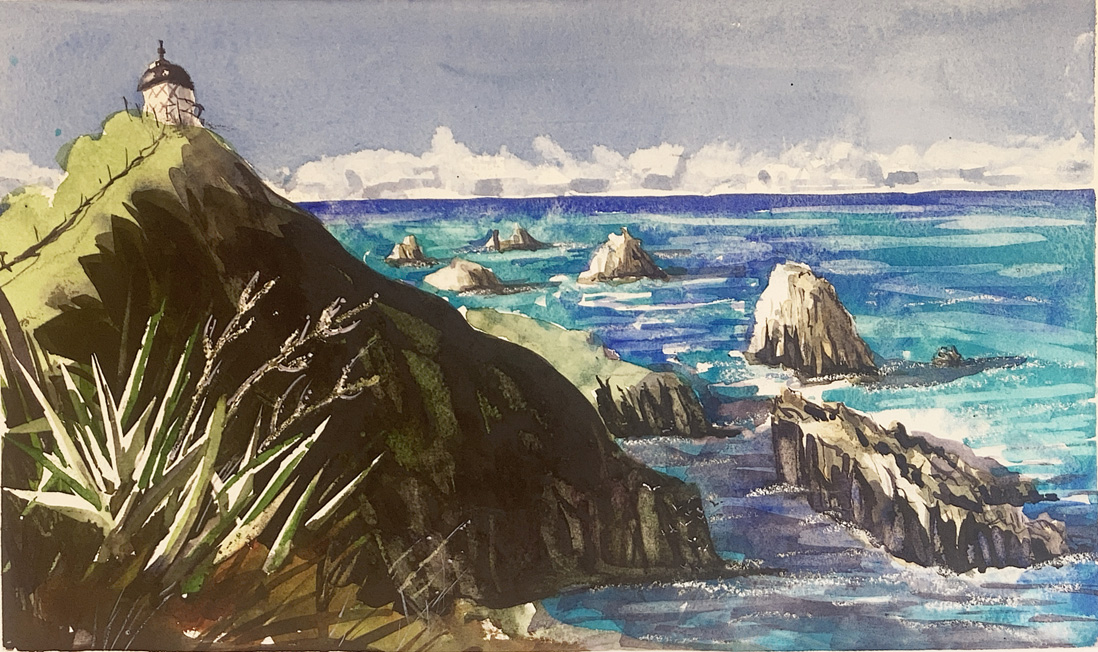
I learnt so much from that first plan and painting that the
second one is markedly better – look at the preserved whites
on the closest rocky islets. Now my focal point is for real.
This painting was completed using techniques gleaned from some of my books:
blotted clouds, magic tape/packaging tape masking on the flax, lifting out ‘white’
ripples in the sea, some pastel for sea foam, white gouache for the flax against
the big dark area. Learning never ends with this amazing medium.
But the important point is that in amongst those tweaks I had a plan. Watercolour
rewards a decisive, positive brush stroke. Hesitate to execute and the most
unsophisticated viewer of your work will see that indecisiveness in your image.
Making a written plan will give you the confidence and control to paint deliberately
and confidently. Try it for your next painting. Think about the necessary steps and
processes. Scribble a simple plan on the masking tape on the side of your paper. Then execute your plan!
To finish, here is my favourite quote about watercolour:
“In watercolour, if you are not in trouble, then you’re in trouble” – Selma Blackburn
Welcome to your painting life, on the edge of trouble.